by Sharon Borg Schembri
As the school year comes to an end, many families are preparing for transitions to summer school programmes, new classrooms, different Learning Support Educators (LSEs), or entirely new schools.
One concern I hear repeatedly from parents is:
”I just wish I didn’t have to keep explaining how to communicate with my child every time there’s a change in staff or place.”
Families often spend years learning what supports successful communication, what may lead to frustration, and which strategies help their daughter/son feel safe, understood, and able to participate. Yet during transitions, this valuable knowledge does not always transfer easily from one setting to another.
A new teacher, LSE, therapist, or support worker may not know that a person needs extra processing time before responding, uses gestures to communicate important needs, benefits from visual supports, or requires space when feeling overwhelmed. Without this knowledge, communication breakdowns can occur, leading to frustration, anxiety, and reduced participation.
This is where a Communication Passport can make a significant difference.
What is a Communication Passport?
A Communication Passport is a person-centred document that provides essential information about an individual’s communication preferences, strengths, needs, and support strategies.
It acts as a practical guide for anyone supporting the individual, helping them understand how to communicate effectively and how to create successful interactions from the very beginning.
Unlike a detailed assessment report, a Communication Passport is written in a clear, accessible format that can be easily understood by teachers, support staff, therapists, carers, and community members.
The focus is not on diagnosis but on the person.
A Brief History of Communication Passports
Personal Communication Passports were first developed by speech and language therapist Sally Millar through a project at CALL Scotland in 1991. Their purpose was to create a practical and person-centred way of sharing essential information about persons who could not easily communicate important details about themselves.
Since then, Communication Passports have become widely recognised as a valuable tool for supporting persons with complex communication needs across educational, healthcare, and community settings.
Why Are Communication Passports Important?
Communication is much more than spoken language. It includes gestures, facial expressions, body language, AAC systems, behaviours, routines, and person preferences.
Those who know a person well often learn to interpret subtle communication signals that others may miss.
During transitions, this knowledge can be lost.
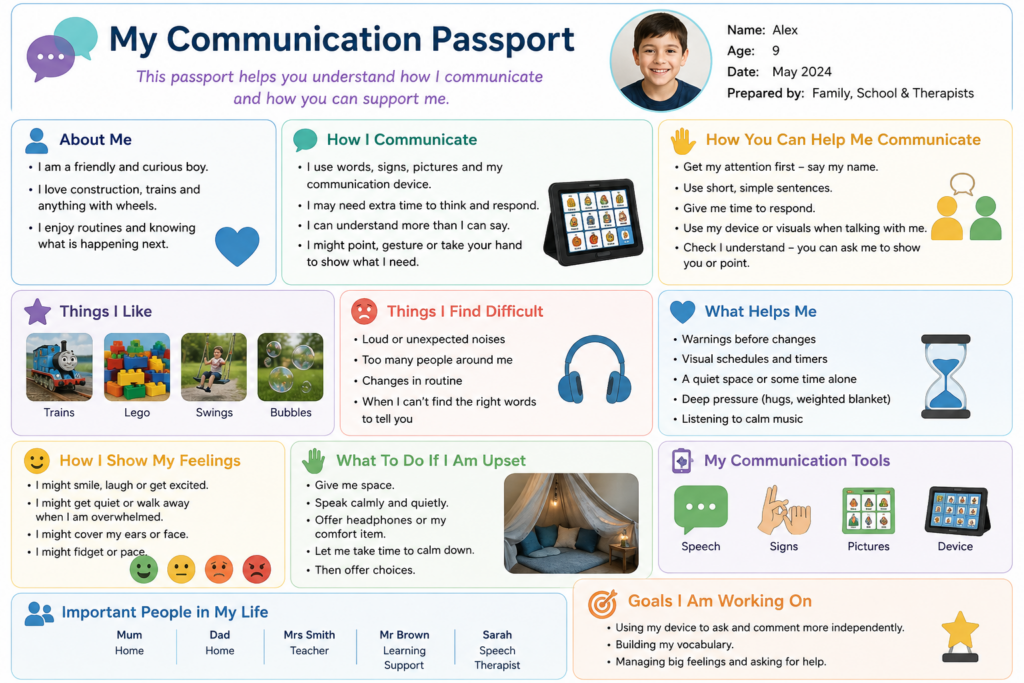
A Communication Passport helps ensure that important information travels with the person, allowing new communication partners to understand:
- How the person communicates
- What motivates and interests them
- What support strategies are effective
- What situations may cause distress or anxiety
- How to respond when the person becomes overwhelmed
- How to support participation and independence
Rather than starting from scratch, new staff can build upon existing knowledge and relationships.
When Should a Communication Passport Be Used?
Communication Passports are particularly useful during:
Summer School Programmes
Temporary staff can quickly understand how best to support communication and participation.
Change of Learning Support Educator (LSE)
A passport provides continuity when a person begins working with a new support professional.
Transition to a New Class
Teachers can gain valuable insight before the school year begins.
Transition Between Schools
Important communication information can follow the person into a new educational environment.
Healthcare or Residential Services
New professionals can establish effective communication from the outset.
Community Activities
Sports clubs, holiday programmes, youth groups, and respite services can all benefit from understanding how a child communicates.
What Should a Communication Passport Include?
Every Communication Passport is unique, but common sections include:
- About me
- My strengths and interests
- Important people in my life
- How I communicate including AAC systems, communication boards, signs, or devices I use
- How you can help me communicate
- Things I like and dislike
- My sensory preferences
- What may cause me stress or anxiety
- What helps me when I am upset or overwhelmed
- Current goals and priorities
The most effective passports are developed collaboratively with the person, family, educators, and therapists.
Benefits of Communication Passports
For Children and Young People
- Reduced anxiety during transitions
- Increased participation and inclusion
- Better understanding by unfamiliar adults
- Improved communication opportunities
- Greater confidence and self-advocacy
For Families
- Confidence that important information is being shared
- Less need to repeatedly explain communication needs
- Improved consistency across settings
- Stronger collaboration with professionals
For Professionals
- Faster understanding of individual needs
- More effective communication from the start
- Better continuity of support
- Enhanced person-centred practice
Free Communication Passport Resources
If you would like to create a Communication Passport, CALL Scotland offers a range of free templates, examples, and guidance for families and professionals. You can access these resources here:https://www.communicationpassports.org.uk/
You can also create a digital communication passport using Book Creator.
Final Thoughts
Transitions are a natural part of life, but for persons with communication needs they can bring real uncertainty if key information does not travel with them.
A Communication Passport helps ensure that what is already known about a person, their ways of communicating, what supports them, what helps them feel safe, and how they participate, does not get lost between settings. Instead, it gives new staff a clear, practical starting point so communication can continue, rather than restart. By sharing what matters most about how a person communicates, we can reduce misunderstandings, promote participation, and help every person feel understood from day one.
At AccessNow360, we can support families, schools, and professionals to create and use Communication Passports so that communication strategies are understood and followed across all environments.