
Expression in Action
Literacy for All Children
By Dr. May Agius
Introduction
When we think about literacy, what is the first thing that comes to mind?
Reading?
Writing?
Perhaps spelling, handwriting, or comprehension?
For many of us, literacy begins when a child starts to read words on a page or write sentences in a book. Yet long before children learn to read and write, they are developing something even more fundamental: the ability to communicate, share ideas, and make meaning.
A toddler points towards a favourite toy.
A child tells a story about what happened at the weekend.
A learner asks a question, expresses an opinion, or explains a solution.
These are all acts of communication. They are also the foundations upon which literacy is built.
When children struggle with literacy, our first instinct is often to look at reading or writing skills. We ask whether they know their sounds, whether they can spell, whether they can write a sentence independently. But what if the challenge lies even earlier? What if the difficulty is not reading or writing itself, but the language needed to understand, organise, and express ideas?
This article explores the relationship between communication, language, and literacy. It examines why expression matters, how communication supports literacy development, and how approaches such as AAC, Universal Design for Learning, and emerging technologies can help create more opportunities for every child to participate as a communicator, a learner, and ultimately, a reader and writer.
Because literacy does not begin with a pencil.
It begins with meaning.
Literacy Begins with Communication
Literacy is often described as the ability to read and write. While these skills are undoubtedly important, literacy is fundamentally about making meaning and participating in the world through language.
Before children learn to decode printed words, they learn to communicate.
They learn that sounds, gestures, facial expressions, symbols, pictures, and words all carry meaning. They learn that communication allows them to share experiences, ask questions, solve problems, and connect with others.
Communication provides the foundation upon which language develops, and language provides the foundation upon which literacy develops. Put simply:
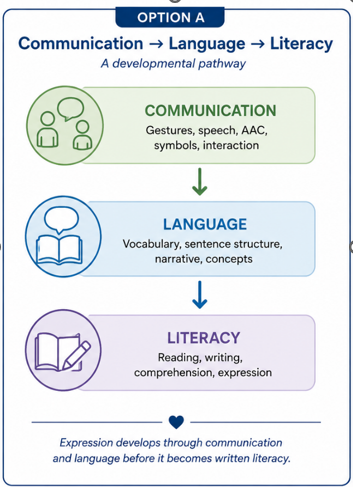
This progression is not always obvious because many children move through these stages naturally. However, for learners who experience difficulties with communication or language, the impact on literacy can be significant.
- A child who struggles to understand vocabulary will often struggle with reading comprehension.
- A child who has difficulty organising ideas verbally may also struggle to organise ideas in writing.
- A child who rarely has opportunities to express opinions, tell stories, or explain their thinking may find it difficult to produce extended written text.
Literacy does not emerge in isolation. It develops through meaningful communication experiences.
Speaking Is Not the Same as Expressing
One of the most common assumptions in education is that if a child can talk, they are ready for literacy.
In reality, many learners who speak fluently still experience significant difficulties with language and literacy.
They may use short, simple sentences.
They may struggle to explain their thinking.
They may find it difficult to sequence events, describe experiences, or retell stories.
They may know what they want to say but lack the vocabulary or language structures needed to express it effectively.
These challenges are not always visible in everyday conversation. They often become apparent only when children are expected to read complex texts, write extended responses, or explain their reasoning.
This is why literacy support cannot focus solely on reading and writing skills. We must also consider the language that underpins those skills.
The question is not simply:
“Can this child talk?”
The question is:
“Can this child use language to describe, explain, predict, compare, persuade, and tell stories?”
These are the skills that literacy demands.
Expression Before Composition
When we think about writing, we often focus on what appears on the page.
Yet before a sentence can be written, it must first be imagined.
- A child must generate an idea.
- Organise their thoughts.
- Select vocabulary.
- Construct sentences.
- And decide what message they want to communicate.
In other words, writing begins long before transcription.
This distinction is often described as the difference between composition and transcription.
Composition involves generating and organising ideas.
Transcription involves getting those ideas onto paper or a screen.
Many literacy interventions focus heavily on transcription skills such as handwriting, spelling, and typing. These are important skills, but they are only part of the picture.
A child may produce very little written work because handwriting is difficult.
Equally, a child may produce very little written work because they struggle to develop, organise, and express ideas.
Both barriers deserve attention.
Supporting literacy therefore means supporting expression.
AAC and Literacy: More Than a Communication Tool
Augmentative and Alternative Communication (AAC) is often associated with individuals who are minimally speaking or non-speaking.
However, the principles that underpin AAC can support literacy development for many learners.
AAC makes language visible.
It provides access to vocabulary.
It supports sentence construction.
It creates opportunities for participation.
Visual supports, communication boards, symbol systems, graphic organisers, and speech-generating devices can all help learners organise ideas and express themselves more effectively.
Importantly, these supports are not only valuable for learners who use AAC as their primary means of communication.
Many learners benefit from visual representations of language, particularly when learning new vocabulary, constructing sentences, or planning written work.
AAC reminds us that communication is not limited to speech and that there are many ways to support expression.
Creating Multiple Pathways to Participation
If literacy is about making meaning, then learners need multiple opportunities to demonstrate understanding and share ideas.
This principle sits at the heart of Universal Design for Learning (UDL).
Rather than expecting every learner to communicate in exactly the same way, UDL encourages us to provide multiple means of engagement, representation, and expression.
Some learners may explain their understanding verbally.
Others may use visuals, symbols, AAC, drawing, typing, or speech-to-text tools.
The goal remains the same: meaningful participation in learning.
When we provide multiple pathways for expression, we create more opportunities for learners to develop the language and communication skills that underpin literacy.
New Opportunities Through AI
Emerging technologies such as Artificial Intelligence are creating new possibilities for supporting expression.
AI can help learners generate ideas, expand vocabulary, organise information, and develop written language.
For example, a learner might use AI to brainstorm story ideas, expand a simple sentence, or explore alternative vocabulary choices.
Used thoughtfully, these tools can reduce barriers and provide additional scaffolding during the composition process.
Like all educational tools, AI should support learning rather than replace it.
Its greatest potential lies in helping learners participate more fully in communication and literacy activities.
Implications for Practice
Understanding the relationship between communication, language, and literacy has important implications for educators and families.
- Recognise communication as the foundation of literacy.
- Create regular opportunities for learners to express ideas through discussion, storytelling, and collaborative activities.
- Look beyond reading and writing when literacy difficulties arise.
- Use AAC and visual supports to make language more accessible.
- Provide multiple means of expression so that all learners can participate.
- Use technology strategically to remove barriers and support communication.
Most importantly, remember that literacy begins with meaning. Before children become readers and writers, they are communicators.
Supporting communication is therefore one of the most powerful literacy interventions we can provide.
Conclusion
Every child has ideas worth sharing.
Every child has experiences worth describing.
Every child has a voice that deserves to be heard.
When we recognise communication and language as the foundations of literacy, we begin to see literacy differently. We move beyond reading and writing as isolated skills and understand them as part of a much broader process of meaning-making, participation, and expression.
The question is no longer:
“Can this child read and write?”
Instead, we ask:
“How can we help this child express what they know, think, and feel?”
Because literacy does not begin with words on a page.
It begins with communication.
And every child deserves the opportunity to be heard!