
From First Marks to Meaningful Text
Rethinking Writing for Every Learner
By Sharon Borg Schembri
Introduction
When you see a child who produces very little written work, what is your first thought?
Is it that they are not trying hard enough? That they do not like writing? That they have nothing to say?
What if none of those are true? What if the barrier is not the thinking…..but the expression? Or not even the expression, but simply the tool?
Writing is one of the most complex skills we ask children to develop. Yet when a child struggles, we often look at the output – the marks on the page, the words on the screen, the absence of either – and draw conclusions that may have nothing to do with what is actually happening.
For some learners, the barrier is expressive – organising thoughts, finding words, constructing sentences. For others, the barrier is physical – the pencil is simply not an efficient or accessible tool. A child with motor difficulties, low muscle tone, or a physical disability may have lots to say, but holding and controlling a pencil takes everything they have – leaving nothing for the thinking, the organising, or the writing itself.
This article is an invitation to look differently. To understand what writing really involves, what gets in the way for many learners, and how we can ensure that every child, regardless of their profile, their disability, or their starting point, has a genuine pathway into written expression.
Because every child has something to say, our job is to make sure they have a way to say it.
What Writing Really Is
Writing is not a single skill. It is a complex, multi-layered developmental process that involves many different cognitive, linguistic, and physical abilities working together simultaneously.
When we ask a child to write, we are asking them to:
- Generate ideas — to think of something worth saying
- Organise their thinking — to sequence and structure those ideas coherently
- Access vocabulary — to find the right words to express those ideas
- Construct sentences — to translate ideas into grammatically structured language
- Transcribe — to physically produce the written form, whether by hand, by typing, or by another means
- Review and revise — to re-read, evaluate, and refine what has been written
Research in writing development consistently highlights that skilled writing requires the automatic coordination of these processes. So, these processes do not happen one at a time, but they happen simultaneously, and they compete for the same cognitive resources. Recent research confirms this picture and suggests that when lower-level skills such as handwriting or spelling are not yet automatic, they consume cognitive resources that should be available for higher-level thinking, which includes planning, organising, and composing. For a child who finds any one of these steps difficult, the entire process can break down, not because they have nothing to say, but because the demands of the task exceed their available capacity at that moment.
This is why two children can produce very different amounts of written work and yet have very similar things to say. The difference is not always ability. It is often the ‘pencil’ they are using.
And crucially, writing begins long before a pencil touches paper. It begins with a scribble, a symbol, a selected word, a dictated sentence. It begins with intent and meaning. The form comes later.
Function Before Form
One principle ran through everything we know about supporting diverse writers:
Function before form.
This means that before we focus on how a child writes – the neatness of their letters, the accuracy of their spelling, the length of their sentences – we must first ask whether they have a means of expression and whether they have access to the writing process in a way that works for them. Because in this context:
- A child who scribbles with intent is a writer.
- A child who selects a symbol on their device is a writer.
- A child who dictates using speech-to-text is a writer.
- A child who types because holding a pencil takes everything they have, is also a writer.
This is not about lowering expectations. It is about recognising that the goal of writing is communication — the transmission of meaning from one mind to another. And that goal can be achieved through many different means.
Writing development requires:
- Building skills — explicitly teaching the mechanics of writing, from letter formation to sentence structure to text organisation
- Removing barriers to access — ensuring that physical, cognitive, or linguistic difficulties do not prevent a child from participating in the writing process while those skills are being developed
As Koppenhaver and Yoder (1993) noted in their foundational work on literacy for individuals with complex communication needs, literacy is not a privilege reserved for those who can hold a pencil. It is a right — and it is our responsibility to find the pathway that works for each individual child.
Matching Supports to the Writing Process
Once we understand writing as a multi-stage process, we can begin to match supports more precisely to where a learner is experiencing difficulty. Not every child needs the same support — and not every support addresses the same barrier.
Supporting Idea Generation and Organisation
- Talking before writing — structured discussion with parents or relating stories, partner talk, or recorded voice notes to externalise thinking
- Mind mapping tools — both paper-based and digital, helping learners see connections between ideas
- Graphic organisers — visual frameworks that help learners plan and sequence their ideas before writing begins
- AI tools for idea generation — emerging technologies that can prompt, scaffold, and support the brainstorming process
Supporting Vocabulary and Sentence Construction
- Word banks and word walls — topic specific vocabulary made visible and accessible
- Sentence starters and sentence frames — providing the linguistic scaffold while the learner supplies the meaning
- AAC and visual supports — AAC systems can serve as a powerful vocabulary resource during writing
- Predictive text and word prediction software — reducing the cognitive load of word retrieval and spelling
Supporting Transcription
- Scribing — a human scribe who writes as the learner dictates, removing the physical barrier entirely.
- Typing — keyboards, adapted keyboards, and on-screen keyboards
- Speech-to-text — allowing the learner to dictate their ideas while technology handles the transcription
- AAC systems — for learners who use high-tech communication devices, these can also serve as writing tools
Supporting Review and Revision
- Text-to-speech — allowing learners to hear their writing read back to them
- Structured revision frameworks — simple checklists that guide learners through the review process
- Peer review with scaffolding — supported peer feedback using structured prompts
Effective writing instruction for diverse learners requires both explicit skills teaching and meaningful supported practice — with tools and strategies matched carefully to individual need.
Every Child is a Writer — Implications for Practice
Understanding writing as a complex, multi-stage process — and recognising that barriers can exist at any point along that process — has profound implications for how we teach, support, and assess writing in our classrooms and therapy rooms.
1. Presume competence
Every child has something to say. Our starting point must always be the assumption that the thinking is there — even when the written output does not yet reflect it. This means asking not “Can this child write?” but “What does this child need in order to write?”
2. Recognise that writing begins with meaning
Before we worry about letter formation, we must celebrate the intent behind the mark. A scribble that tells a story. A symbol chosen with care. A word selected from a communication device. These are the earliest acts of writing — and they deserve to be recognised and celebrated as such.

The child tells the story. The adult writes it down.
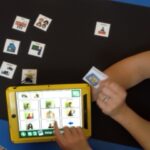
3. Separate the message from the medium
Writing assessment and instruction should, wherever possible, separate a learner’s ideas and thinking from the physical means by which those ideas are expressed. A child who dictates a beautifully structured paragraph is demonstrating writing competence — even if they have not produced a single mark on paper.
4. Introduce tools early and teach them explicitly
Assistive technology and low-tech supports are most effective when they are introduced early, taught explicitly, and used consistently across settings. A speech-to-text tool that a learner encounters for the first time in an exam is not a support — it is an unfamiliar obstacle.
5. Build the skills and remove the barriers — simultaneously
Function before form does not mean abandoning the mechanics of writing. Handwriting, spelling, punctuation, and sentence structure all matter and deserve systematic, explicit teaching. The point is to pursue both goals at the same time — so that no learner is left waiting for their skills to catch up before they are allowed to participate. It is also about identifying when an ‘alternative pencil’ is required.
6. Collaborate across disciplines
Supporting diverse writers is not the sole responsibility of the classroom teacher. It requires genuine collaboration between teachers, learning support educators, speech-language therapists, occupational therapists, and families. At AccessNow360, this collaborative, multidisciplinary approach is at the heart of everything we do.
Conclusion
Writing is one of the most powerful tools we give children. It is a means of communication, of self-expression, of participation in the world. And it is a right, not a privilege reserved for those who can hold a pencil, sit still at a desk, or produce neat letters on a page.
When we understand writing as the complex, multi-layered process it truly is – and when we commit to both building skills and removing barriers simultaneously – we change what is possible for every learner in our care.
We stop asking “Why isn’t this child writing?” and start asking “What does this child need in order to write?”
Every child is a writer. Not every child has yet been given the pathway that works for them.
That is our challenge, and our privilege as the adults who support them.
At AccessNow360, we provide specialist support in AAC, Assistive Technology, and literacy for diverse learners — working with individuals, families, schools, and organisations locally in Malta and internationally. If you would like to find out more about how we can support you, get in touch at accessnow360@gmail.com or visit accessnow360.com
If you found this post useful, please share it with a colleague — you never know whose practice it might change. 🌟
Further Reading
Bereiter, C., & Scardamalia, M. (1987). The psychology of written composition. Lawrence Erlbaum Associates.
Flower, L., & Hayes, J. R. (1981). A cognitive process theory of writing. College Composition and Communication, 32(4), 365–387.
Graham, S., Harris, K. R., & Larsen, L. (2001). Prevention and intervention of writing difficulties for students with learning disabilities. Learning Disability Research & Practice, 16(2), 74–84.
Graham, S., Kim, Y. S., Cao, Y., Lee, W., Tate, T., Collins, P., Cho, M., Moon, Y., Chung, H. Q., & Olson, C. B. (2023). A meta-analysis of writing treatments for students in grades 6–12. Journal of Educational Psychology, 115(7), 1004–1027.
Kim, Y. S. G., & Graham, S. (2022). Expanding the direct and indirect effects model of writing (DIEW): Reading–writing relations, and dynamic relations as a function of measurement/dimensions of written composition. Journal of Educational Psychology, 114(2), 215–238.
Koppenhaver, D. A., & Yoder, D. E. (1993). Classroom literacy instruction for children with severe speech and physical impairments (SSPI): What is and what might be. Topics in Language Disorders, 13(2), 1–15.